



On the last Thursday in May 1381, a royal commissioner called John Bampton sat down at Brentwood in Essex with his clerks and his lists, and sent for the men of three villages.
The villages were Fobbing, Corringham and Stanford, small places on the edge of the Thames estuary, where the land runs flat down to the mud and the sheep graze out on the marshes. Bampton had come about money. According to his lists, these villages owed the King tax, and had not paid it.
The men of Fobbing sent a spokesman, a man called Thomas Baker. He told the commissioner that Fobbing had paid already, and that it would not be paying again. Bampton was used to being obeyed. He ordered his sergeants to arrest them.
It did not go the way he expected. The villagers had come armed, and some of them had brought bows. Within a very short time the King’s commissioner was on his horse and riding hard for London, and the men of Fobbing had gone back into the country, knowing exactly what they had done. That was the beginning.
The tax was a poll tax. ‘Poll’ was an old word for the top of your head, and a poll tax was paid by every person, counted one head at a time.
It was the third in four years. The first, in 1377, had asked a groat, a silver coin worth fourpence, from everyone over fourteen. The second had been graded, so that a duke paid more than a ploughman. The third was the heaviest of all. It worked out at a shilling a head for everyone over fifteen, three times as much as the first, and a shilling was several days’ wages for a working man. The richer people in each village were supposed to help the poorer ones pay. In villages where nobody was rich, everybody paid in full.
The money was for the war with France, which had been going on for more than forty years and was no longer going well.
So the villages did what people have always done with a tax they cannot pay. They made people disappear. When the collectors came to count heads, daughters and widows and old servants were somehow not at home, and did not exist. On paper, England seemed to lose about a third of its grown-up population between the first tax and the third. In Essex, nearly 48,000 people had paid in 1377. In 1381 the county found only a little over 30,000.
The King’s Council was not fooled. In the spring of 1381 it sent commissioners out into the counties to go village by village and find the missing people, and the missing shillings. John Bampton was one of them.
The villages had seen men like him before. For thirty years local justices had enforced the Statute of Labourers, fining ploughmen for asking too much and servants for leaving their masters, and every fine was remembered. Now the same kind of men were back, with the same kind of lists.
A few days after Brentwood the government sent somebody more important. Sir Robert Belknap was the Chief Justice, one of the most senior judges in England, and he came into Essex to find the troublemakers and punish them. The villagers chased him out too. Some of the men who had been helping him were killed, and one chronicler says Belknap himself was made to swear on the Bible that he would never sit in judgement on them again.
After that there was no going back, and everybody knew it.
Messengers went from village to village. Church bells were rung to call people out. Across the estuary in Kent the same thing was happening, and the two counties were in touch almost from the first day. It happened too quickly to have been an accident. Men on trial afterwards spoke of a ‘great society’ that had organised it all, meeting in secret, though nobody has ever discovered whether it was real.
In Kent the spark was one man’s freedom. A knight of the King’s household, Sir Simon Burley, came to Gravesend and claimed that a man living in the town was his serf. He had the man locked up in Rochester Castle, and to understand why that mattered so much, you need to know what a serf was.
A serf, or villein, belonged to a manor. He was not a slave, but he was not free either. He could not leave the manor without his lord’s permission. He owed his lord days of unpaid work every year, ploughing and reaping the lord’s fields before he could see to his own. When his daughter married he paid a fee, and when he died his family paid another, often his best animal. His children were born serfs, and so were theirs.
All of this was written down. Every manor kept court rolls, long strips of parchment stitched end to end and rolled up tight, and on them the lord’s steward recorded the names of his serfs and what each of them owed. If you wanted to know whether a man was free, you looked at the rolls, so wherever the rebels went, they found the rolls and burned them.
Early in June the men of Kent took Rochester Castle with hardly a fight and let the prisoners go, Burley’s man among them. At Maidstone they chose a leader, a man called Wat Tyler, and broke open the Archbishop of Canterbury’s prison, where they found a priest called John Ball.
Almost nothing is known about Wat Tyler before that summer. His name suggests that he, or his father, laid roof tiles for a living, but nobody is sure even of that, or of where he came from. Some historians have guessed that he had been a soldier in France, because he knew so well how to lead men. What everybody agrees on is that he was quick and bold, and that within a few days thousands of people were doing what he said.
They marched to Canterbury and walked into the cathedral in the middle of the service. According to one chronicler, they told the monks to choose a new Archbishop, because the present one was a traitor and would soon be dead.
That Archbishop was Simon Sudbury. He was also Chancellor of England, the King’s chief minister, and it was Sudbury who had stood up in Parliament the winter before and asked for the third poll tax. Sudbury had another reason to fear the men of Kent. The priest they had let out of his prison at Maidstone was one of his own prisoners. The Archbishop had locked him up that spring for preaching without permission, and it was not the first time. His name was John Ball.
John Ball had been in trouble with the Church for twenty years. He had no parish of his own. He wandered the countryside preaching in churchyards and on village greens, wherever people would stop to listen, and what he preached made bishops very uneasy. He said that the rich had too much and the poor too little, and that God had never meant it to be so. He had been thrown into prison for it more than once, and each time he came out he started again.
On the twelfth of June the rebels of Kent camped on Blackheath, a wide open common on the high ground a few miles south-east of London. Imagine it that evening: the smoke of hundreds of cooking fires, tired feet, the noise of a crowd that has walked a long way, and the city spread out below them across the river.
John Ball stood up in front of them and preached. He began with a rhyme that people may well have known already.
‘When Adam delved and Eve span, who was then the gentleman?’
To delve is to dig. To span is to spin wool. In the beginning, Ball said, when Adam dug the earth and Eve spun the thread, there were no lords and there were no serfs. God had made everyone alike. Serfdom had come afterwards, the work of wicked men, and now the time had come to throw it off.
It was a dangerous question. It was also a very simple one, and once it had been asked out loud in front of thousands of people, it could not be unasked.
We know what Ball said because a monk of St Albans Abbey called Thomas Walsingham wrote it down, and his own abbey was attacked by rebels that same week. Almost everything we know about the rising comes from men like him: monks, clerks, royal officials, and a French chronicler who spent his life among lords and kings. They were frightened and angry, and they were on the other side. The rebels left almost nothing in their own words, only a handful of short, puzzling letters in rhyme that were passed from hand to hand and that nobody has ever fully understood.
So when the chroniclers call the rebels a mob of drunken thieves, it helps to remember who was holding the pen. When they say the rebels did terrible things, it also helps to remember that some of them did.
The strangest thing about the rebels is that they loved the King. When they stopped travellers on the road, they asked them a question. ‘With whom hold you?’ The right answer was ‘With King Richard and the true commons.’ They did not believe the King was their enemy. They believed he had been surrounded by bad advisers, and that if they could only reach him and explain, he would put everything right, but the King was only fourteen years old.
King Richard was the son of the Black Prince, the great soldier of Crécy and Poitiers, who had died before he could become king. When King Richard’s grandfather, old King Edward the Third, died in 1377, the boy was crowned at the age of ten, and powerful uncles ran the kingdom around him. The most powerful of them was John of Gaunt, Duke of Lancaster, the richest man in England and the man the rebels hated most. That June he was far away in Scotland.
Now King Richard was in the Tower of London with his mother, his Archbishop, his Treasurer and a few hundred soldiers, watching smoke rise on the far side of the river.
On the morning of the thirteenth of June, which was the feast of Corpus Christi, he went down the Thames in the royal barge to meet the rebels at Rotherhithe. They were waiting on the bank in their thousands, and when they saw him they set up such a roar that his advisers took fright. The barge stayed out on the water. The King did not land, or was not allowed to, and after a little while the oarsmen turned it round and took him back to the Tower.
If the King would not come to the rebels, they would go to him.
London Bridge was the only bridge across the Thames, and in the middle of it was a drawbridge. That afternoon somebody on the city side let it down, and the men of Kent poured across. On the other side of London, somebody opened Aldgate to the men of Essex. Plenty of Londoners had grievances of their own, and a great many of them joined in.
One of the first places they went was the Savoy.
The Savoy was John of Gaunt’s palace on the Strand, beside the river, and it was said there was no finer house in England. The rebels set it on fire. They had made a rule among themselves that nothing was to be stolen, because they were not thieves, so they carried out the treasures and destroyed them instead. They smashed the silver plate and broke up the jewels and threw the pieces into the Thames. Tapestries and fine clothes were set on fire. According to one chronicler, a man caught hiding a silver cup inside his coat was thrown into the flames after it. Some barrels were rolled onto the fire in the belief that they were full of gold. They were full of gunpowder.
They went on to the Temple, where the lawyers lived and worked, and carried the lawyers’ books and papers out into the street and burned them. They broke open the prisons and let everybody out.
There was worse. In the Vintry, the riverside quarter where the wine merchants traded, rebels and Londoners together hunted down Flemish men and women. Weavers from Flanders had been invited to England by the old King and given special protection, and some Londoners had resented them for years. The rebels dragged a group of Flemings out of the church where they had taken shelter and killed them in the street, only because they were foreign.
By nightfall London was in the hands of the rebels, and the King sat in the Tower and watched it burn.
The next morning King Richard rode out to Mile End, a stretch of open fields a mile beyond the city wall to the east, where the men of Essex were waiting for him. They had brought with them a list of what they wanted, and now they put it to the King as a petition..
They asked that nobody in England should be a serf any longer. They asked to rent their land for fourpence an acre a year, paid in money, instead of paying with days of unpaid work. They asked to be free to buy and sell in any market in the country. They asked that no man should have to serve another except by his own agreement. They asked for a pardon for everything they had done.
King Richard said yes, and he said yes to all of it.
Clerks were set to work at once, writing out charters of freedom, each one sealed with the King’s own seal. Men from each village waited for theirs, and then, holding their parchments, many of them turned for home.
However, not everybody went. While the King was at Mile End, a crowd of rebels went back to the Tower, and this time the gates were not shut against them. They found Archbishop Sudbury in the chapel, where he had been praying. They found Sir Robert Hales, the Treasurer, who looked after the King’s money. They dragged both men out to Tower Hill and cut off their heads, and set the heads on poles above the gate of London Bridge.
King Richard could not go back to the Tower that night. The next day, Saturday the fifteenth of June, he went to Westminster Abbey and prayed at the shrine of Edward the Confessor. Then, in the afternoon, he rode out to Smithfield to meet Wat Tyler.
There are two Smithfields in London, and they are easy to muddle. East Smithfield lies beside the Tower, and it was there, thirty-two years earlier, that the plague dead of 1349 had been laid in their long rows. West Smithfield is on the other side of the city, just outside the old wall to the north-west. It was a wide, flat field where horses were sold on Fridays and where traitors were sometimes put to death, with the priory and hospital of St Bartholomew along one side.
So on a June afternoon, the sons and grandsons of the people who had buried the dead at one Smithfield came to stand on the other.
The rebels drew up in ranks on the west side of the field. The King and his party waited on the east side, in front of St Bartholomew’s. The Mayor of London, a fishmonger called William Walworth, rode across to fetch Tyler, and Tyler came over on a small horse with a dagger in his hand.
What happened next was written down by a chronicler who seems to have been there, or to have talked to somebody who was.
Tyler got down from his horse, half bent his knee, and took the King’s hand and shook it hard. ‘Brother,’ he said, ‘be of good comfort and joyful.’ Within a fortnight, he told King Richard, the commons would think better of him than ever, and they would be good companions.
Then he set out new demands, bigger than the ones at Mile End. No lord should have power over other men, and all people should be equal, except for the King. The Church’s wealth should be taken and shared among the people of each parish. There should be only one bishop in all England. There should be no more serfs anywhere, and every man should be free.
King Richard answered carefully. They should have everything he could fairly grant, he said, saving the rights of his crown.
Tyler was hot, the chronicler tells us. He called for a jug of water and rinsed out his mouth in front of the King, very rudely. Then he called for ale, drank a long draught, and climbed back onto his horse.
At that moment a young man from Kent in the King’s party said, loudly, that he knew this Wat Tyler, and that he was the greatest thief and robber in all Kent.
Tyler went for him with the dagger. Walworth rode in and tried to arrest him. Tyler struck at the Mayor, but Walworth was wearing armour under his gown and the blade did not go through. Walworth drew his own sword and cut Tyler across the neck and the head, and one of the King’s squires, usually named as Ralph Standish, ran him through.
Tyler turned his horse and rode a short way towards his own people, calling on them to avenge him. Then he fell to the ground.
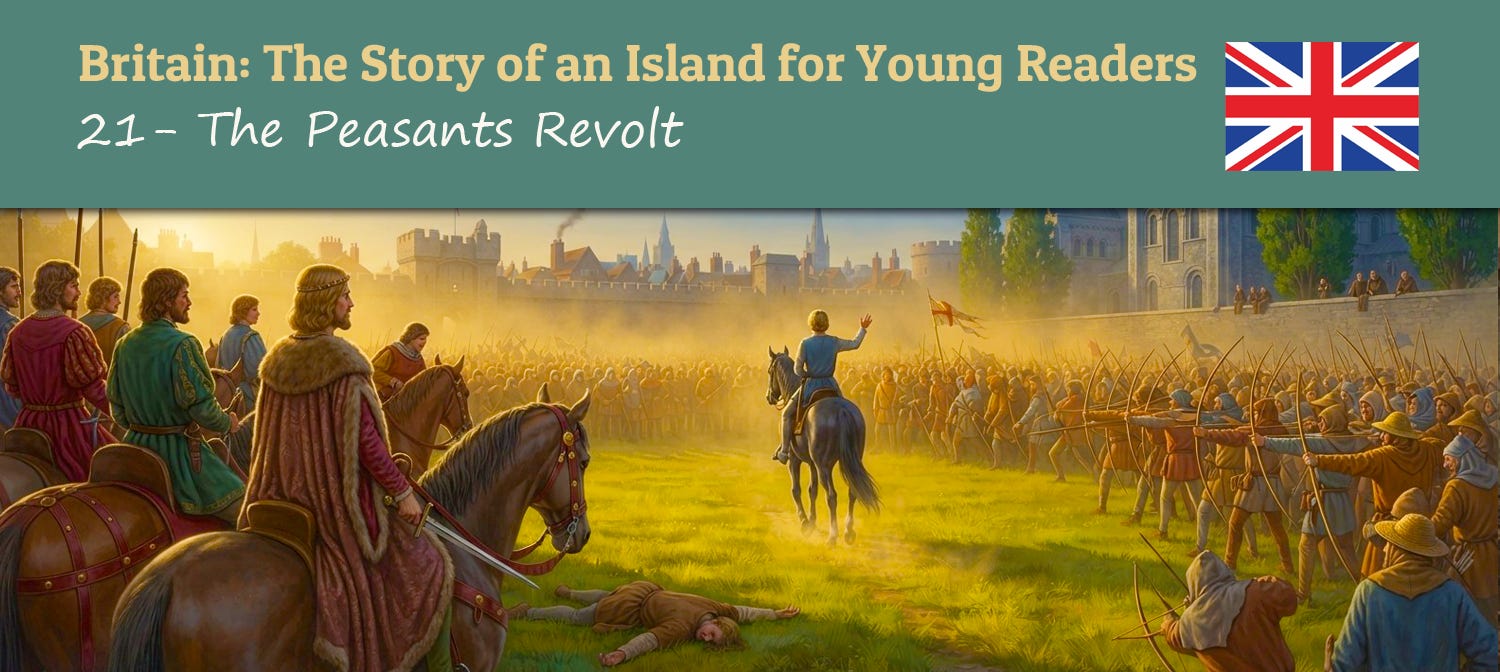
Across the field the rebels saw it. Many of them had been archers in the French wars, and they drew their bows and aimed them at the King’s party.
King Richard put spurs to his horse and rode out towards them, across the open ground.
The chroniclers remember his words differently. In one account he calls out, ‘Sirs, will you shoot your King? I will be your captain.’ In another he tells them they shall have from him all that they seek, and that they must follow him.
And they did. The rebels lowered their bows and followed a fourteen-year-old boy on a horse out of Smithfield to the open fields at Clerkenwell.
While they were there, Walworth galloped back into the city and raised the armed men of the London wards, and before long the rebels found themselves surrounded, penned in, the chronicler says, like sheep.
Then Walworth went back to Smithfield to finish what he had started. Wat Tyler was no longer lying on the grass. His friends had carried him into the hospital of St Bartholomew and put him to bed in the master’s own room. Walworth had him brought out into the middle of Smithfield and cut off his head, and carried it on a pole to the King in the fields at Clerkenwell.
When the rebels saw it, they knew it was over. They went down on their knees among the wheat and begged for mercy. They could have been cut down where they stood, but the King would not allow it. He let them go home, and sent two knights to lead the men of Kent safely back through London and over the bridge.
Walworth was knighted before the day was out. Tyler’s head was later set on London Bridge.
For the men walking home, it looked as though they had won. They had their charters. They had the King’s word, given twice, but it only lasted about a week.
On the twenty-second of June, at Waltham in Essex, a group of rebels came to ask the King to confirm what he had promised at Mile End. According to Walsingham, Richard gave them their answer to their faces. ‘Villeins ye are still, and villeins ye shall remain.’ Promises made under threat, he said, counted for nothing. At the beginning of July the charters were cancelled.
Then came the judges. The new Chief Justice, Sir Robert Tresilian, went through Essex and Hertfordshire trying rebels, and the King rode with him. Out in the eastern counties, where the rising had spread as far as Norfolk, the Bishop of Norwich put it down with armed men. Thomas Baker of Fobbing, who had faced the commissioner at Brentwood, was hanged. John Ball was caught at Coventry and brought to St Albans, and there, in the middle of July, with the King in the town, he was hanged, drawn and quartered.
The surviving records name around a hundred and fifty men put to death in the months that followed, and there were very likely more. In December the King and Parliament granted a pardon to almost everyone else, and the country went quiet.
The rebels had lost. Yet the poll tax was dropped, and it was more than a hundred years before an English government dared to try another. Serfdom, which Richard had refused to end, went on dying anyway. Over the next hundred years or so, lords found it easier to take rent in money from free tenants than to force unpaid work out of people who could simply walk off down the road. Nobody ever signed an end to it. It faded away, one manor at a time, until the rolls had no serfs left to record.
If you go to West Smithfield today, you will find the great Victorian market halls, with the City’s dragons standing guard over the gateways. Across the road is the long wall of St Bartholomew’s Hospital, which has stood on that spot since 1123 and is still a hospital. On that wall there are memorials. One remembers William Wallace, the Scottish leader, put to death at Smithfield in 1305. Another remembers the Protestants burned here in the reign of Queen Mary. The newest, a carved stone put up in 2015, says that at this place Wat Tyler, John Ball and the representatives of the Great Rising met King Richard, and that the King agreed to what they asked, and afterwards went back on his word.
The boy who turned his horse towards the archers that afternoon would be king for another eighteen years. He never forgot Smithfield, and neither did the men who had watched him there. What he made of it is the next story.