



The arrow struck him just below the eye, by his nose.
Prince Henry was sixteen years old. It was July 1403, and he was standing in a field a few miles north of Shrewsbury, in the middle of the first great battle of his life. One of the thousands of arrows that fell that day found the prince’s face and drove deep into the bone.
His companions wanted to carry him away. The story goes that he refused, because a prince taken off the field would make his men lose heart. So he stayed and fought on until the battle was one, all the while with the arrow still in the face.
Afterwards, the doctors tried to pull it out. The wooden shaft snapped off in their hands, and the iron head stayed where it was, buried about six inches deep into his skull.
Help came from a London surgeon called John Bradmore. He invented a tool for the job: a pair of small hollow tongs with a screw running down the middle. Over several days he gently widened the wound with little plugs of elder pith soaked in honey of roses. Then he slid the tongs into the hole, found the socket of the arrowhead and turned the screw. The tongs opened inside the socket and gripped. Slowly, a little at a time, Bradmore drew the arrowhead out.
He washed the wound with white wine and dressed it with honey, and he changed the dressings every day for twenty days until the wound closed. Honey fights infection, although in 1403 nobody knew why. The prince lived, and because Bradmore wrote the treatment down, we know how it was done.
This was the same boy King Richard II had knighted in Ireland four years before. His father, Henry Bolingbroke, had taken Richard’s crown and become King Henry IV, and Richard had died a prisoner in Pontefract Castle. Nobody knows how or why he died, but many people believed the new king was a thief.
A crown taken by force is hard to keep. The problems began in Wales. A lord called Owain Glyndŵr led his people in a long uprising against the king. Then the Percys, the great family of the north who had helped Henry IV to his throne, turned against him too. The Earl of Northumberland’s son, Harry Percy, was so quick to come to the fight that people called him Hotspur. It was Hotspur’s army that Prince Henry faced at Shrewsbury, and by the end of that hot July day, Hotspur lay dead.
The battle of Shrewsbury was only the beginning. Once his face had healed, the prince spent years fighting in the hills of Wales. It was a hard fight, but he learned. He learned how to besiege a castle and how to feed an army in wild, empty country, but most importantly, he learned how to be patient. Wars, he discovered, are won by carts of bread and careful planning as much as they are by battle.
Nearly two hundred years later, Shakespeare wrote about a wild young Prince Hal who drank in London taverns with a fat old knight called Falstaff. While there may be a grain of truth in that tale, the real Prince Henry had spent most of his youth in army camps and council chambers, carrying more responsibility than most grown men.
In March 1410 Prince Henry was at Smithfield, just outside the walls of London, when a Worcestershire craftsman called John Badby was brought out to die. Badby was put inside a large empty barrel and the fire was lit around it. When he cried out, the prince ordered the fire put out. He promised Badby his life, and money from the royal treasury every year for as long as he lived, if only he would take back what he had said.
Badby was a Lollard. The Lollards followed the teaching of John Wycliffe, an Oxford scholar. They wanted the Bible in English, so that ordinary people could read it for themselves, and they also said that the Church had grown far too rich. Most shocking of all, they said that the bread blessed by the priest at Mass was still only bread. To most people in England this was a terrible sin, and in 1401 a law was passed that heretics who would not give up such beliefs should be burned alive.
Badby refused. The prince had him put back into the barrel, and the fire was lit again.
People who watched that day did not know which to wonder at more, the prince’s mercy or Badby’s courage.
Meanwhile his father was growing ill. King Henry IV’s skin broke out in a disfiguring disease, and he began to suffer fits that left him helpless. As the king weakened, the prince took more and more of the government into his own hands, until in 1411 father and son quarrelled and the prince was sent away from the King’s Council.
King Henry IV had always dreamed of going on crusade to Jerusalem, and an old story says he had been told he would die there. In March 1413 he collapsed while praying in Westminster Abbey and was carried into the abbot’s house. When he came round, he asked the name of the room. It was called the Jerusalem Chamber. Then he knew, he said, that he would die there. And so he did.
His son, Prince Henry, was crowned a few weeks later while snow fell over Westminster. By now, the prince who had received an arrow to the face was twenty-six years old. People who knew him described a slender young man, strong and quick, with a long straight nose, a ruddy face and smooth dark hair. His eyes, they said, were as gentle as a dove’s until he was angry, and then they were a lion’s. The best-known portrait of him shows him from the side. Some historians wonder whether that hid the scar Bradmore’s tongs had left behind.
The new King Henry began his rule gently. He pardoned old enemies, and he gave Hotspur’s son back his father’s lands. And, as you may remember, he had King Richard’s body carried to Westminster Abbey and laid beside Queen Anne, as Richard had wished. But then he went to war.
France was a rich and proud kingdom with a troubled king. King Charles VI suffered from bouts of madness that came and went for thirty years. A pope who wrote about him later said that Charles sometimes believed he was made of glass, and had iron rods put into his clothes so that he would not shatter if he fell.
With their king so often helpless, the great lords of France fought each other for power. In 1407 the king’s brother, the Duke of Orleans, was murdered in a Paris street on the orders of his cousin, the Duke of Burgundy. After that France split into two bitter parties, and each was ready to bargain with the English against the other.
King Henry V saw his chance. His great-grandfather Edward III had claimed to be the rightful King of France through his French mother, and Henry pursued that claim again. He asked for the French crown or, failing that, great lands in France, a fortune in gold and the hand of King Charles’s daughter, Catherine, in marriage. In reply, the French offered a good deal, but it was not enough.
All through 1414 and the spring of 1415, England prepared for war. Henry built warships, among them a great ship called the Trinity Royal, and he gathered hundreds more. He collected guns big enough to batter stone walls. Above all, he gathered archers. Of the 12,000 or so men who sailed with him, about four in every five carried a longbow.
On 11 August 1415 the fleet sailed from the Solent. Two days later the army began coming ashore at the mouth of the river Seine, close to the port of Harfleur.
Henry expected Harfleur to fall quickly. It did not. For five weeks his guns pounded the walls, and every night the townspeople patched the holes with timber and earth. The English camp lay in low, wet ground in the heat of late summer. The water was foul, the food went bad, and then the sickness came.
It was dysentery, a disease of the gut that spreads through dirty water. Men called it the bloody flux. Nobody knows how many died, but many more were too ill to fight and had to be shipped home. Among the dead were the Earl of Suffolk and Richard Courtenay, Bishop of Norwich, one of the king’s closest friends, and King Henry ordered that the bishop be buried in Westminster Abbey, among the kings.
Eventually Harfleur surrendered on 22 September 1415. Four days later the king sent a challenge to the Dauphin, as the French king’s eldest son was called, offering to settle the whole war by fighting him man to man. The Dauphin did not reply.
It was autumn now, and Henry’s army was smaller and sick. His captains told him the sensible thing was to sail home. Henry would not go home with one small town to show for it all. Instead he decided to march overland to Calais, the English town on the French coast that Edward III had captured almost seventy years before. It was more than a hundred miles away, and each man was told to carry food for eight days.
King Henry planned to cross the river Somme at Blanchetaque, the tidal ford where Edward III’s army had crossed just before the battle of Crécy. But as they drew near, they heard that a French army was waiting on the far bank. Instead, they turned inland and marched upriver, looking for another way across, while the French kept pace with them on the other side of the water.
It rained almost every day. The eight days’ food ran out. Day after day the men trudged on through the mud, soaked and hungry and often sick, deeper and deeper into France.
A priest who travelled with the army wrote down what he saw. When one soldier stole a pyx, the small box that held the holy bread in church, King Henry had him hanged from a tree.
On 19 October they found two places where they could cross, at the villages of Béthencourt and Voyennes. The causeways over the marshes had been broken, so the English mended them with timber pulled from nearby houses, and by nightfall the whole English army had crossed over.
King Henry had already given an order that would matter more than any other. Every archer was to cut a stake about as long as a man is tall and sharpen it at both ends. If the French horsemen charged, the archers would drive their stakes into the ground in front of them, points slanting outwards, so that the horses would run onto them.
A few days later, French heralds rode into the English camp and asked, very politely, which road the king meant to take.
‘Straight to Calais,’ said King Henry.
It was not much of an answer, as there was no other road he could take.
On 24 October, as the English came over a rise near the village of Blangy, they saw the French army spread out in front of them, right across the road to Calais.
How many were there? Nobody knows for certain. Some historians today think the French had around 12,000 fighting men against nearly 9,000 English. Others think the English had only about 6,000, and the French two or three times as many. Either way, King Henry’s men were outnumbered and a long way from home. They would have to fight their way through or surrender.
One of the king’s knights, Sir Walter Hungerford, said aloud that he wished they had another ten thousand English archers with them. The king rounded on him. ‘Don’t you know,’ he said, ‘that the Lord, with these few, can overthrow the pride of the French?’ Shakespeare later turned that moment into the speech in which Henry calls his men ‘We few, we happy few, we band of brothers.’
That night the English camped around the village of Maisoncelles, and King Henry ordered complete silence. Anyone who made a noise could lose an ear. The men made their confessions to the priests. Across the dark fields, the French camp was full of noise. It was said afterwards that the French lords spent the night throwing dice for the prisoners they expected to take.
Friday 25 October was the feast of Saint Crispin and Saint Crispinian, two brothers who had worked as shoemakers. Between the armies lay a long, narrow field of soft earth, newly ploughed and soaked with rain, with the wood of Agincourt on one side and the wood of Tramecourt on the other.
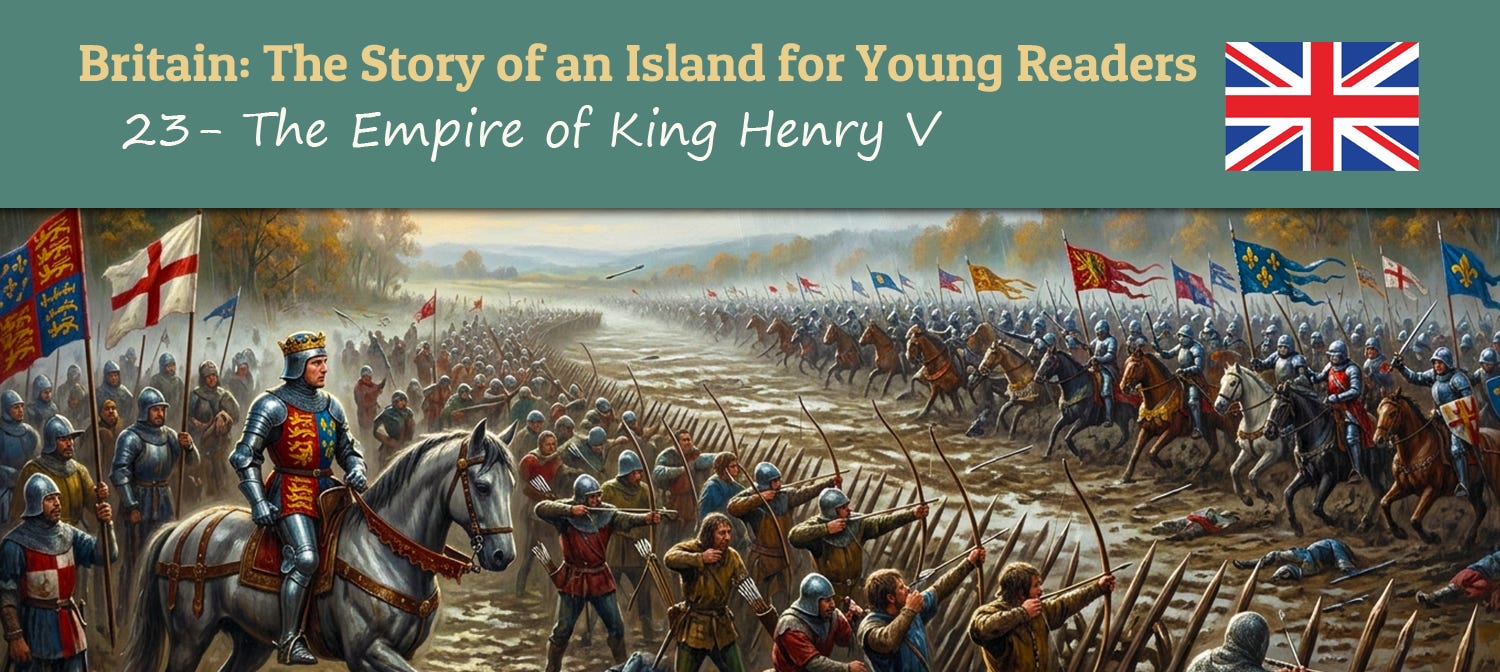
Henry rode along his line on a small grey horse. Over his armour he wore a coat that bore the golden lions of England and the golden lilies of France, and on his helmet he wore a crown. Everyone on that field, friend or enemy, could see exactly where the King of England was.
The English stood in one long, thin line, the men-at-arms on foot in the middle and most of the archers at either end. All morning, nothing happened. The French saw no reason to hurry, but King Henry could not wait, because his men had almost nothing left to eat.
At about eleven o’clock, King Henry gave the order to advance the banners. The archers knelt, made the sign of the cross and kissed the ground, and some, it is said, put a little earth in their mouths. Then the whole English army walked forward across the mud. The archers pulled up their stakes, carried them closer and hammered them in again within bowshot of the French. Far behind them, among the baggage carts, the priest who was keeping the record sat on his horse and prayed, and then the English archers began to shoot.
Thousands and thousands of arrows fell on the crowded French ranks. The French horsemen on the wings charged, but there were fewer of them than had been planned, and the woods on either side kept them from riding round behind the English. The English archers aimed at the horses, and the maddened animals turned and bolted, straight back into their own men-at-arms coming forward on foot.
Then came the main French attack. Thousands of knights and men-at-arms in plate armour trudged forward across the ploughed field. The mud sucked at their feet, and it grew deeper with every step, churned up by the horses. Worst of all was the crush. The field was narrow, and more and more men were pressing on from behind, until the front ranks were squeezed so tightly together that some could hardly raise their arms to swing a sword.
When they reached the English line, the first Frenchmen fell, and the men behind stumbled over them and fell too. Soon there were heaps of men in armour lying in the mud, some dead, some wounded and some simply unable to get up again while others trampled over them.
Then the English archers threw down their bows. They were lightly dressed and quick on their feet, and they ran out among the struggling knights with hatchets and swords and the heavy wooden mallets they had used to drive in their stakes, killing whoever they came upon.
King Henry was in the thick of it. His youngest brother, Humphrey, was wounded and fell, and the king stood over him to protect him until he could be dragged clear. During the fight, a blow from an axe struck the king’s helmet so hard that it broke off a piece of his crown. Some writers said the blow came from the Duke of Alençon, one of the greatest lords of France, who fought his way to the king before he was cut down.
By early afternoon the first two French lines were broken, and a great many French lords had surrendered.
One French lord had led a band of horsemen and peasants round behind the English lines to raid the baggage carts, and they carried off one of the king’s crowns. At some point in the afternoon, King Henry believed he was being attacked from behind, while the last French line, still fresh and unbroken, seemed to be getting ready to charge. The English had more prisoners than they could guard, and the field was littered with weapons the prisoners could pick up, so King Henry gave the order to kill all the French prisoners.
His knights refused. To kill a man who had surrendered was shameful, and a captured lord was worth a fortune in ransom. So the king sent archers to do it. No one knows how many prisoners died before the last French line drew back and King Henry called off the killing. It may have been fewer than people afterwards believed. But men who had given themselves up, trusting that their lives would be spared, were killed in cold blood. People argued about that order then, and they argue about it still today.
The battle was over in about three hours. Perhaps six thousand Frenchmen had been killed, among them three dukes, nine counts and around a hundred of the greatest lords in France. The English records name a little over a hundred of their own dead, though the true number may have been several times that. Among them were the king’s cousin, the Duke of York, and the young Earl of Suffolk, whose father had died of the flux at Harfleur only five weeks before.
That evening, the story goes, King Henry asked the French herald the name of the castle he could see nearby. Azincourt, he was told. Then the battle would be called Agincourt.
Azincourt is still a small village, and the battlefield is still farmland. In autumn the fields are ploughed, and when it rains the earth turns to the same heavy, clinging mud.
A few days later the English army limped into Calais. In November King Henry arrived home in London, and the whole city turned out to see him. There were giant figures on London Bridge and children dressed as angels singing in the streets. King Henry rode through the crowds in a plain gown. According to the chroniclers, he would not let his battered helmet and bent sword be carried before him. The glory, he said, belonged to God.
But a battle does not win a kingdom. King Henry returned to France in 1417 with a larger army, and one by one the towns and castles of Normandy fell to him. In the summer of 1418, King Henry laid siege to Rouen, the capital of Normandy. Food inside the walls ran so short that the people of Rouen pushed more than 12,000 of their poorest neighbours out of the gates, but King Henry would not let them through his lines. They were trapped in the ditch below the walls, between the two opposing armies, as winter came on. On Christmas Day the king allowed two priests to bring them food. The next day it stopped. Many of those people died in that ditch, and in January 1419, Rouen surrendered.
Meanwhile the French were still at each other’s throats. Later in 1419, the Duke of Burgundy, the same man who had ordered the murder of the Duke of Orleans in Paris twelve years before, went to a peace meeting on a bridge at Montereau with the new Dauphin, Charles, who had become the king’s heir after his two elder brothers died. While they talked, the Dauphin’s men cut the duke down with an axe. His son was so furious that he joined the English.
Now France had nowhere left to turn. In May 1420, in the city of Troyes, poor mad King Charles signed a treaty. He would keep his crown for the rest of his life, but when he died it would pass to King Henry and Henry’s children, and never to his own son, the Dauphin. Less than two weeks later, King Henry married Charles’s daughter, Catherine, in the cathedral at Troyes.
There was one more change, quieter than any battle, that has lasted far longer. From 1417, King Henry began writing his letters in English. Kings since the Norman Conquest had written in French or Latin, the languages of lords and churchmen, but King Henry started writing in the language of his archers and soldiers. His clerks followed his lead, and many historians think the way they wrote helped shape the English language we write today.
For a moment, King Henry V stood higher than any English king before him. He was King of England, master of Normandy and heir to the crown of France, and there was talk of him leading all the kings of western Europe on a crusade to win back Jerusalem.
King Henry did not rule his empire for long. In the cold, damp siege camp at Meaux, east of Paris, he probably caught the same sickness that had killed so many of his men at Harfleur. He died in the castle of Vincennes, near Paris, on the last day of August 1422. He was thirty-five years old.
As the priests read the psalms beside his bed, they came to the words ‘Build thou the walls of Jerusalem.’ The king stopped them. He said he had always meant, if God let him live, to rebuild the walls of Jerusalem. They were almost his last words.
Charles VI died seven weeks later. If Henry had lived just two months longer, he would have been King of France. Instead both crowns passed to his son, Henry VI, then a baby only nine months old.
King Henry’s body was brought home and buried in Westminster Abbey, and you can still visit him there. His tomb lies at the eastern end of the chapel of Edward the Confessor, under a little stone chapel. On the tomb lies his likeness, a figure carved in oak. Once it had a head of silver. But one night in 1546 thieves stole it, and for more than four hundred years the tomb of King Henry V lay headless. The head he has now was made in 1971.
A few steps away lie Richard II and Queen Anne, in the tomb where King Henry laid Richard beside his queen. And a few yards from King Henry, under the floor, lies Richard Courtenay, the bishop who died of the flux at Harfleur and was buried among the kings because King Henry wished it. His grave was never marked, and it was not found again until 1953.
King Henry had spent his life winning a kingdom in France, and he left it to a baby who could not yet walk.
But King Charles’s son, also called Charles and known as the Dauphin, had never accepted the treaty. He still held the lands south of the River Loire, and he called himself King of France. The war would go on, fought by grown men in a baby’s name.
Meanwhile, far away in the east of France, in a village called Domrémy, a girl of about ten was helping to look after her father’s animals. Her name was Joan. Today we call her Joan of Arc. In a few years she would begin to hear voices, and the voices would tell her to drive the English out of France.