



On the third of May 1389, the great council of England met at Westminster. The bishops, lords and clerks took their places, and the business of the day began. Then King Richard II interrupted them.
He wanted to know, he said, how old he was.
It was an odd question, because everyone in the room knew the answer, King Richard included. They told him anyway. He was twenty-two.
‘Then I am a grown man,’ said Richard. Any heir in England could take charge of his own lands once he came of age. Was the King to be the only man in the kingdom who could not? For twelve years other people had ruled for him. From now on he would choose his own advisers, and he would be king in more than name.
Before the great council was over, King Richard had asked for the Great Seal, two metal discs that pressed the King’s picture into wax on the most important documents in the kingdom, to show they carried his authority. The Chancellor who kept it was Archbishop Thomas Arundel, whose own brother had helped to humble the King the year before. The Archbishop handed it over.
Nobody tried to stop King Richard. Some of the men in that room had come close to taking Richard’s crown less than eighteen months earlier, and they had put his friends to death. The young king was calm and polite and pleasant. He also did not look like a man who had forgotten anything, and he hadn’t.
To understand what lay behind that pleasant face, we have to go back a few years.
Richard had been King since he was ten. His father, Edward the Black Prince, the famous soldier who had won the battle of Poitiers, died a year before the old King, Edward III, and so the crown passed straight to the old King’s grandson. Richard had been born in Bordeaux, in the part of France the English kings still ruled, and he grew up clever, quick and very sure of what a king should be.
At fourteen, he had ridden out at Smithfield to face Wat Tyler’s rebels and turned them away with a few words. It was the bravest thing he ever did. It may also have taught him something dangerous, that a king who spoke for himself could do what a room full of councillors never would.
After Smithfield the grown-ups took charge again. The real power lay with Richard’s uncles. The greatest of them was John of Gaunt, Duke of Lancaster, who held more land than any other lord in England and took his odd name from Ghent, the Flemish city where he was born. The youngest was Thomas of Woodstock, later Duke of Gloucester, a fierce, proud man who longed for glory in France.
King Richard chose friends of his own. Robert de Vere, Earl of Oxford, was charming, good company and not especially wise, and Richard heaped gifts on him until he was Duke of Ireland. Michael de la Pole, the son of a rich merchant from Hull, became Chancellor and Earl of Suffolk. Sir Simon Burley had fought beside the Black Prince and been Richard’s tutor when he was a boy. Richard trusted him more than anyone alive.
The great lords could not stand any of them. Worse, Richard did not want to fight the French. The war that his father and grandfather had won so gloriously at Crécy and Poitiers was going badly now, and Richard thought it cost a great deal and won very little. To the lords, a king who would not fight was hardly a king at all. One chronicler sneered that the knights around Richard were knights of Venus, the goddess of love, rather than of Bellona, the goddess of war.
In the winter after Smithfield, Richard married Anne of Bohemia, the daughter of the Holy Roman Emperor, from Prague, a city in the middle of Europe. They were both fifteen. It was a marriage of state, but they grew to love each other. More than once, when King Richard was angry with somebody, it was Anne who pleaded with him for mercy.
The marriage also opened a road between England and Bohemia, and in time scholars would travel along it to Oxford to read the books of a priest called John Wyclif.
Wyclif believed that the Church had grown too rich and too proud, and that ordinary people had a right to read the Bible for themselves. The Bible in England was in Latin, which few people outside the Church could understand, and Wyclif’s followers set to work translating it into English, so that a ploughman or a weaver could hear the Gospels in the language he spoke at home.
In May 1382 the new Archbishop of Canterbury, William Courtenay, gathered a council of churchmen at the Blackfriars in London to condemn Wyclif’s ideas. While they were meeting, the ground began to shake. An earthquake rolled under London and the south-east that day, and some of the churchmen were frightened and wanted to stop. Courtenay told them it was a good sign. The earth, he said, was casting out foul air, just as their council would cast out false teaching. Wyclif’s friends said the earthquake was God’s anger at the council. The council carried on, and Wyclif’s teaching was condemned.
Wyclif left Oxford for his parish of Lutterworth in Leicestershire, and he died there at the end of 1384. Years later the Church had his bones dug up and burned, and the ashes were thrown into the River Swift. But it was too late. The scholars from Bohemia had carried Wyclif’s books home to Prague, where a preacher called Jan Hus took up his ideas, and the arguments Wyclif had started would one day help to split the Church of western Europe in two.
In the autumn of 1386, the storm broke. John of Gaunt had sailed for Spain to try to win the crown of Castile, and with him out of the way, Gloucester moved against King Richard. At his side was the Earl of Arundel, whose great castle stands above the River Arun in Sussex. Arundel was a hard, proud soldier, and he never troubled to hide how little he thought of Richard.
Parliament demanded that Richard dismiss his Chancellor, Michael de la Pole. Richard refused. According to one chronicler, he said he would not dismiss so much as a scullion from his kitchen because Parliament asked him to.
So Gloucester and the Earl’s brother, Thomas Arundel, who was then a bishop, rode out to the King’s palace at Eltham in Kent and reminded him of a story. There had once been a king who would not listen to his lords, they said. His name was Edward II, and his people had taken his crown away.
Edward II was Richard’s great-grandfather, and Richard knew how that story ended. He gave way. De la Pole lost his office, and a council of lords was set over the King for a year to run the kingdom in his place.
Even a poet felt the change. Geoffrey Chaucer, who checked the taxes on wool in the port of London and lived in rooms over the city gate at Aldgate, lost his home that autumn and gave up his post in December. It was probably in the quieter years that followed that he began to write The Canterbury Tales.
However, King Richard did not sit quietly. For most of 1387 he kept away from London, gathering men in the Midlands and the north and in his own earldom of Chester, which was famous for its archers. In August he called his judges to Nottingham, and there the Chief Justice, Sir Robert Tresilian, the same judge who had tried the rebels after Smithfield, gave the King the answer he wanted. The council forced on him was against the law, the judges declared, and the men who had forced it on him were traitors.
Many historians think the judges were right about the law. Right or not, it was a declaration of war.
Gloucester, Arundel and the Earl of Warwick gathered their men and marched on London. They became known as the Lords Appellant, because they appealed the King’s friends, which meant that they formally accused them of treason. Two younger lords joined them, Thomas Mowbray, Earl of Nottingham, and Henry Bolingbroke, Earl of Derby.
Henry was John of Gaunt’s son and King Richard’s first cousin. He was born at Bolingbroke Castle in Lincolnshire, probably within a few months of Richard, and as boys the two of them had been named to the Order of the Garter on the same day. But Henry was everything the lords wished King Richard would be, a champion in the jousting lists who would later go crusading in the forests of Lithuania. Now he had chosen a side against the King.
In December 1387, Robert de Vere marched south from Cheshire with an army to rescue King Richard. Just before Christmas, at Radcot Bridge on the upper Thames, he found one bridge broken down and Henry’s men holding the other. De Vere’s army was routed. He spurred his horse into the river, and as night came on he slipped from the saddle, pulled off his armour and swam for his life.
His horse and armour were found by the water next morning, and many thought he had drowned, but he had not. He had escaped overseas, and five years later a wild boar killed him while he was out hunting.
Now King Richard was alone. The Appellants surrounded him in the Tower of London and argued among themselves about whether to take his crown away altogether. The older men were for it. Henry and the younger lords were against it, and in the end the lords drew back. King Richard kept his crown, but he was allowed to keep very little else.
In February 1388 Parliament met to try the King’s friends. When Richard spoke up for one of them, the Appellants threw down their gauntlets in challenge, and some three hundred others threw theirs down too. People afterwards called it the Merciless Parliament, and it earned its name.
De Vere and de la Pole had already fled abroad, and they were condemned to death without being there. Tresilian had not got away. He was found hiding in the sanctuary of Westminster Abbey, dragged out and hanged at Tyburn the same day.
The death that hurt most was Simon Burley’s. Richard pleaded for him. So did another of his uncles, Edmund, Duke of York, and even Henry and Mowbray argued that Burley should be spared. Queen Anne, it is said, went down on her knees before the Appellants to beg for his life. They would not listen. In May, Burley was beheaded on Tower Hill.
King Richard was twenty-one. He had been made to stand by while the man who had taught him and the friends he loved were killed one after another, all in the name of the law. Afterwards he made his peace with the lords, swore new oaths, and waited.
That vengeful wait is what lay behind the pleasant face in the council chamber a year later.
For eight years after that May morning, King Richard ruled carefully and well. He made his peace with his uncle Gaunt, who came home from Spain that autumn. He took no revenge on anybody, and in time he even let Gloucester and Arundel back onto his council.
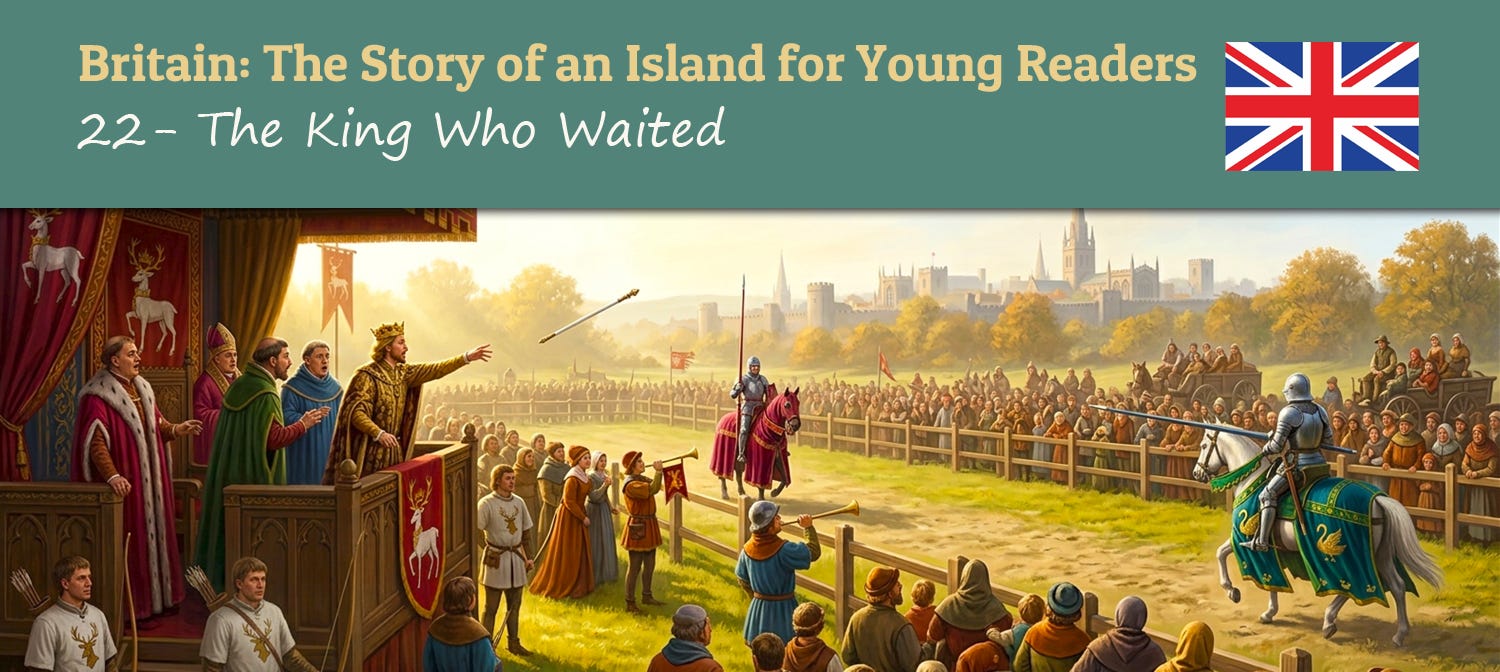
King Richard loved beautiful things as few English kings had before him. In October 1390 he held a great tournament at Smithfield, on the same field where he had faced Wat Tyler, and the King’s knights wore a badge that, as far as we know, nobody had seen before. It was a white hart, a pure white stag, with a golden crown around its neck and a golden chain hanging from it. From then on it was Richard’s own sign. His richest friends wore it in gold and white enamel, and his soldiers wore it on their coats.
One of his household accounts even records little pieces of cloth made for the King to carry in his hand, to wipe and clean his nose. People have claimed ever since that Richard invented the handkerchief. He almost certainly did not, but it seems he did not care to use his sleeve to wipe his nose.
And in 1393 he began the work on a building that you can still visit today. Westminster Hall, the enormous hall beside the palace where kings held their feasts and the law courts sat, was three hundred years old, and its roof had probably rested on rows of pillars running down the hall. Richard ordered a new roof that would cover the whole hall in a single span.
The man who built the new roof was Hugh Herland, the King’s master carpenter. Oaks from the royal forests were shaped and fitted together in a yard near Farnham in Surrey, then brought to Westminster by cart and by barge, some 660 tons of them. Great oak beams reach out from the tops of the walls, one above another, and on the end of each of the lowest beams the carvers set a wooden angel with spread wings and holding a shield. Along the walls below, the masons carved King Richard’s white hart again and again.
In June 1394, Queen Anne died at the palace of Sheen, beside the Thames, probably of plague. She was twenty-eight. Richard was wild with grief, and he ordered the palace where she had died to be pulled down.
At her funeral in Westminster Abbey, the Earl of Arundel arrived late. For a moment the mask slipped. King Richard snatched a staff from one of the attendants and struck Arundel across the face, so hard that he drew blood. The monks were horrified that blood had been spilled in their church, but a few weeks later, the King and the Earl appeared to be friends again.
King Richard ordered a tomb for Queen Anne and himself in the abbey, close to the shrine of King Edward the Confessor. Their figures were to be cast in gilded bronze, with their hands joined, and when he died he would lie beside her.
After a campaign in Ireland, Richard married again in 1396. His new bride was Isabelle, the daughter of the King of France. She was six years old. The marriage came with a truce between England and France that was meant to last twenty-eight years, and it meant Richard no longer had to beg Parliament for money to pay for a war.
Then, in the summer of 1397, King Richard carried out his revenge.
In July he invited Gloucester, Arundel and Warwick to a feast. Only Warwick came, and he was arrested. A chronicler tells us that Richard then rode out by night to Gloucester’s castle at Pleshey in Essex and arrested his uncle himself. Arundel gave himself up a few days later.
Gloucester was taken across the sea to Calais, which was then an English town, and in September it was announced that he had died. He had almost certainly been murdered on King Richard’s orders, probably smothered under a mattress.
Parliament met that same month. Westminster Hall was full of scaffolding, so it met in a great timber building in the palace yard, open at the sides, with a company of archers from Cheshire standing all around it with their bows ready. Inside, Parliament gave King Richard everything he asked for. Arundel was condemned and beheaded on the same day. Warwick pleaded guilty and threw himself on the King’s mercy, and was imprisoned on the Isle of Man for life. Archbishop Arundel was sent abroad.
From now on King Richard went nowhere without his Cheshire archers. They spoke to him in their own broad northern speech and called him Dickon. At night, another chronicler tells us, they kept watch outside his chamber and told him, ‘Dickon, sleep securely while we wake.’
That Parliament gave King Richard more power than any king of England had held for generations, then handed its unfinished business to a small committee of the King’s friends and went home. King Richard was master at last.
Only two of the Appellants were left, Henry and Mowbray, and Richard had made both of them dukes. But in December 1397, as the two of them rode together from Brentford to London, Mowbray said something he should have kept to himself. The King, he said, had never forgiven Radcot Bridge. Sooner or later he would come for them too.
Henry repeated it to the King. Each man said the other was lying, and it was decided that the quarrel should be settled the old way, by trial by battle.
A trial by battle looked very much like a joust. It took place in the lists, a long, flat stretch of ground closed in by a wooden fence, with a gate at each end for the fighters to ride in and stands along the sides for the people watching. The two men would charge at each other on horseback with lances, just as knights did in a tournament. But a joust was a game, fought for sport and prizes. A trial by battle could be a fight to the death. When the lances broke, the two men fought on with swords, and they kept fighting until one of them was killed or gave in. Everyone believed that God would give the victory to the one who was telling the truth, and the loser, if he lived, could expect to die as a traitor.
The fight was fixed for September 1398 at Gosford Green outside Coventry, and thousands came to watch. Lists had been built on the green, with a raised stand for the King and his lords. Both men rode in wearing full armour. They took their places at either end with their lances ready, the trumpets sounded, and Henry began to move forward.
He had gone only a few paces when King Richard threw down his staff, the signal to stop. The fight was over before a single blow had been struck.
There then followed two hours of talking, after which Richard gave his judgment. Both men would leave England. Mowbray was banished for life, and he died in Venice a year later. Henry was banished for ten years, which Richard then reduced to six.
Then in February 1399, John of Gaunt died. Henry should have inherited the great lands of Lancaster, the richest inheritance in England. Instead, in March, King Richard took them for himself and made Henry’s exile last for life.
Every lord in England understood what that meant. If the King could take the Duke of Lancaster’s lands, he could take anybody’s.
At the end of May 1399, Richard sailed for Ireland again, taking his Cheshire archers and many of his most loyal lords with him. He left his uncle Edmund of York to look after the kingdom.
At the beginning of July, Henry landed at Ravenspur, a little port at the mouth of the Humber that the sea has long since swallowed. He had only a small band of men with him, and he swore that he had come for nothing but his father’s lands. The great lords of the north soon joined him, led by Henry Percy, Earl of Northumberland, and his son Harry, whose fiery temper had earned him the name Hotspur. At Bristol he caught three of Richard’s ministers and had their heads cut off.
King Richard came back too late. He landed in south Wales towards the end of July, and his army melted away. With a handful of followers he hurried north to the great castle at Conwy. There the Earl of Northumberland came to him and swore on the holy sacrament that Henry wanted only his own lands, and that Richard would keep his crown.
Richard believed him and came out. On the road, Northumberland’s soldiers closed around him, and he was taken to Flint Castle on the estuary of the River Dee.
Henry came to Flint on the nineteenth of August. A French squire called Jean Creton was there, and he wrote down what happened. Henry, in armour, bowed low to the ground, then bowed again with his cap in his hand.
‘Fair cousin of Lancaster,’ said King Richard, ‘you are right welcome.’
‘My lord,’ said Henry, ‘I am come sooner than you sent for me.’ The people of England complained, he said, that Richard had ruled them harshly. ‘But if it please our Lord, I will help you to govern them better than they have been governed in time past.’
Both men knew what those words meant. Another chronicler, Jean Froissart, tells a story about Richard’s greyhound, Math, who would let no one fondle him but the King. That day, Froissart says, Math left Richard’s side and went to fawn on Henry instead.
King Richard rode into London as a prisoner and was shut in the Tower. On the twenty-ninth of September, under pressure we can only guess at, he gave up his crown. The next day the lords and commons gathered in Westminster Hall, under the great new roof he had built. The throne stood empty, covered with cloth of gold. The charges against Richard were read aloud, and the assembly agreed that he should be deposed. Then Henry stood up and claimed the crown, speaking in English, and Archbishop Arundel, home again from exile, took him by the hand and led him to the empty throne.
Richard, no longer king, was moved in secret to Pontefract Castle in Yorkshire, one of the strongholds of Lancaster. In January 1400 some of his old friends plotted to kill King Henry and set Richard free. They failed, and their plot sealed Richard’s fate. By the middle of February he was dead. He was thirty-three.
Nobody knows exactly how he died. Henry’s people said that Richard had refused to eat out of grief. Others said his guards had starved him. Most historians think he died of starvation, whether or not he chose it.
Henry had the body laid out in St Paul’s Cathedral, with the face uncovered from the forehead to the throat, so that everyone could see Richard was really dead. Then he was buried quietly at King’s Langley in Hertfordshire, far from the tomb he had made for himself.
For years afterwards there were stories that Richard was alive and hiding in Scotland. Many of the poor people of England remembered him as the boy who had ridden out to meet them at Smithfield, and they believed he had been their friend. Whether he ever truly was is a question nobody can answer.
King Henry IV kept the crown he had taken, but he never wore it easily. Within a year Owain Glyndŵr had raised Wales against him, and within four years the Percys who had helped him to the throne were fighting to pull him off it. All the while his eldest son, another Henry, was growing up.
Richard had kept that boy close. In the summer of 1399, while the boy’s father was in exile, Richard took him to Ireland, perhaps partly to make sure his father behaved, and knighted him there. When young Henry became King in 1413, one of the first things he did was to bring Richard’s body to Westminster Abbey and lay it in the tomb beside Anne, where Richard had asked to lie.
You can still see them there, two figures in gilded bronze lying side by side under a painted wooden canopy. The hands that Richard asked to be joined broke away long ago.
Go across the road into Westminster Hall and look up. The angels are still there, holding out their shields beneath the dark oak, and Richard’s white hart still lies chained and crowned along the walls. He built that roof to show the world what a king should be. Before the carpenters had even finished it, it was the place where his crown was taken away.
The boy he knighted in Ireland would wear that crown next, and he would carry it to France as King Henry V.