


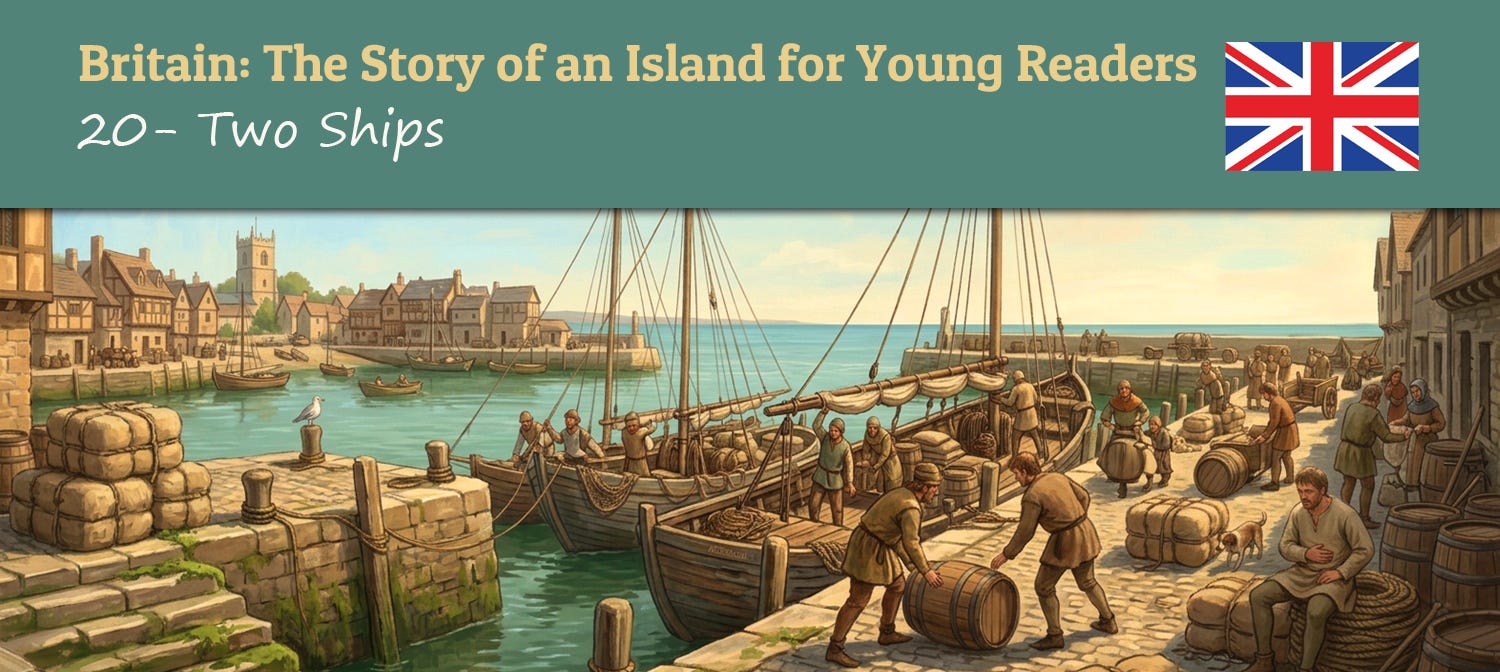
The quay at Melcombe.
Melcombe was a small port in the county of Dorset, on the south coast of England. It was situated on the eastern side of a narrow harbour mouth, and across the water sat its rival, Weymouth. The population of the two towns hated one another, but today the two are one town and nobody remembers the quarrel. In 1348 they were separate places with separate quays.
Ships came from Bordeaux in France and from the Channel Islands and from other English ports, and almost every week, so when two ships came alongside before Midsummer, nobody thought anything of it. One of them had sailed from Bristol. The other had come from Gascony, the English-held wine country in the south-west of France, and crucially one of the sailors aboard was unwell.
That was not unusual. Men often stepped off a ship after weeks at sea with bad water and bad food inside them, and they might be sick for a day or two and then be fine.
A Franciscan friar at King’s Lynn, writing his chronicle some years afterwards, set the story down. Two ships had come in, and a sailor had carried something infectious with him from Gascony. And the men of Melcombe, he wrote, were the first in England to become ill, and those first Melcombe men died within three days.
That is the story as it has been told for six hundred years, and there is a plaque on the quay at Weymouth today that commemorates it. But the friar was writing years afterwards, and he was not the only man writing about this strange sickness that had appeared in England. Other chroniclers said the sickness came ashore first at Southampton, or Bristol, and they gave the date as July, or August, or as late as the end of September. One modern historian has been through every royal and manorial account that survives and found that not one of them mentions pestilence anywhere in England before October.
Nobody was keeping a record at the time, because nobody knew yet that there was anything yet to record. What everyone agrees on is that in the second half of 1348 plague came to England and it arrived on a ship.
It was not called the Black Death then. That name was invented in Scandinavia two centuries later and only became common in English in the eighteen hundreds. To the people who lived through it, it was the pestilence.
To understand what had come ashore, you have to go a very long way to the east of England, and back ten years.
In the foothills of the Tian Shan mountains, in what is now Kyrgyzstan, there was a trading settlement in the Chu valley, on one of the great roads that carried silk and silver west towards the Black Sea. In the years 1338 and 1339 its people began to die in numbers far beyond anything normal, and their graves were cut and their headstones carved in the Syriac script they used. One of those stones can still be read. It says that this is the tomb of Sanmaq, and that he died of pestilence.
For six hundred years nobody could prove what had killed Sanmaq. Historians argued about it, and most of them said the sickness must have begun in China. Then in 2022, a team of historians and geneticists took ancient DNA from the teeth of seven people buried in those graveyards, and found the plague bacterium in three of them. Its name is Yersinia pestis. The strain they recovered turned out to be the direct ancestor of the plague that swept the world in the years that followed.
The disease lives naturally in wild rodents, and in the Tian Shan the rodents that carry it are marmots, fat grass-eating creatures that whistle at each other across the high slopes. Something in those years pushed it out of the marmot burrows and into people. Once it was in people, it travelled the way people travelled, which by then meant everywhere.
The plague reached the Crimea in 1346, when Caffa, a Genoese trading town was under siege. There is a famous story, that the besieging army caught the plague and flung their own dead over the walls with siege engines. The story may or may not be true, as it was told by an Italian lawyer who was not there. What is certain is that the Genoese ships sailed home, that plague came ashore at Messina in Sicily in October 1347, and that by the following summer it had gone through Italy, southern France and Spain and was killing people in Bordeaux and Paris.
England knew the plague was coming. That is easy to forget, because we imagine that the pestilence arrived like weather – out of nowhere. News of the plague arrived via merchants and pilgrims returning from Rome. The King’s envoys at Avignon wrote to the Pope in May 1348 that the English embassy would come at Michaelmas unless the epidemic prevented it.
By high summer the bishops were writing to each other in real fear. On the twenty-eighth of July, William Zouche, Archbishop of York, told his officials that nobody could still be ignorant of what was coming, and ordered processions and prayers twice a week in every church in his diocese. Three weeks later Ralph of Shrewsbury, Bishop of Bath and Wells, warned his clergy that a catastrophic pestilence had reached a neighbouring kingdom, and that unless they prayed without ceasing, it would reach England.
That was all they could do. There was no way to close a coastline that had a hundred harbours and lived by trade, so all they could do was pray and go on with their lives. Meanwhile, King Edward III knew what the pestilence could do. It had already killed his daughter.
Princess Joan was fourteen, King Edward and Philippa’s second daughter, and she had left England in the spring to be married to Pedro, heir to Castile. She travelled with four ships, a hundred men-at-arms, and a wedding wardrobe designed to impress the Spanish court, along with plate, saddles, tapestries, and a gown of cloth of gold. When her fleet reached Bordeaux they were warned not to land, because the plague was in the town. They landed anyway.
Within a fortnight her people began to die. The knight commanding her escort died on the twentieth of August. Princess Joan was moved out to a village in the countryside for cleaner air, but the plague followed her there, and she died on the second of September, having never met the boy she was going to marry. Her body was never brought home.
King Edward wrote to her intended father-in-law in October. It is a strange letter, because you can see a father and a king fighting each other inside the same sentences. He calls Death a destroyer who takes young and old alike and levels rich and poor together. He says no fellow human being should be surprised that he was desolated by grief, since he is human too. Yet this was also the king who had stood outside Calais just over a year earlier, deciding whether to hang six burghers.
So what was bubonic plague?
It is a bacterium that travels in the bite of a flea. Fleas live on rats, and rats lived in every barn and ship and thatched roof in Europe, but fleas live very comfortably on people too, and in their clothing and bedding. The old picture of a black rat scuttling down a mooring rope off an infected ship is probably too simple. The pestilence moved faster than rats move, and it kept moving through communities across the winter. In all likelihood the infection passed from person to person in a household via the fleas and lice that everyone carried on their own bodies.
The flea bite raised a lump. Within a day or two the glands in the groin, the armpit or the neck swelled into a hard and agonising swelling the size of an egg. That swelling was called a bubo, and it is where the word bubonic comes from. Then came fever, thirst, black and purple blotches under the skin where the small blood vessels had burst, and, near the end, a wandering of the mind that the chroniclers called madness. It took three days, sometimes fewer. A man could be well at breakfast and dead before the same time the next day.
There was a second form, worse. If the infection reached the lungs, the sufferer coughed blood and could pass the sickness straight to anyone close enough to breathe it in. That form of plague killed almost everyone who caught it. How much of the mortality it accounts for is still argued over, and over the winter of 1348 into 1349, England was devastated.
What did people think was happening?
The medical faculty at Paris investigated and reported that a conjunction of Saturn, Jupiter and Mars in the sign of Aquarius three years earlier had corrupted the air, and that the corruption was now moving about the world in the air. If bad air was the cause, then smells were the defence. People carried herbs and posies, burned juniper and rosemary indoors, lit fires in the street. And since it was widely observed that the men who cleaned the latrines never seemed to catch it, some took the opposite view and stood over the cesspits on purpose, breathing deeply. Doctors advised against baths, which opened the pores and let the badness in.
None of it worked, though the herbs at least made a sickroom easier to sit in.
In any event, most people believed that the bad air had been sent by God.
This sounds odd, given modern medical understanding, but the men and women of 1348 lived inside a world that made sense as everything was due to the will of God. All this suffering had a purpose, God’s purpose. Then the pestilence came, and it took the wicked and the good, the old and the newborn, the drunkard in the ditch and the nun in the infirmary, and it took the priest who came to hear the confession of the dying and the gravedigger who buried them both. If a merciful God ruled the world, then why was he inflicting such suffering, and that question tore through Europe.
In Kilkenny, a Franciscan friar named John Clyn kept writing his annals while his brothers died around him, eight of them in a single day in March. At the end of his entry for the year he wrote that he was leaving parchment behind, in case anyone should still be alive to carry the work on. Another hand added a note underneath, later, recording that the man who wrote this had died. Nobody filled in the parchment.
From Dorset the pestilence spread along the coast and inland, following the roads and the rivers and the carters and the pack-ponies. Bristol was struck hard and early. Henry Knighton, a canon at the abbey in Leicester who wrote a long chronicle of these years, said that at Bristol almost the entire population died, and that most of the sick died within three days.
The plague reached London in the autumn of 1348. Robert of Avesbury, a clerk at Lambeth and the most reliable eyewitness the city has, dates the first visible signs to All Saints’ Day on the first of November. London then held perhaps sixty thousand people inside its walls and suburbs, and it had no more idea of what to do than Melcombe had. Between February and May of 1349 the epidemic was at its worst. Then the plague spread north and west, into the Midlands, into Wales, into the north country, into Ireland and Scotland, and by 1350 there was hardly a parish that had been spared.
The Scots, according to canon Knighton, watched England suffering and thought their moment had come. They gathered an army in Selkirk Forest, laughing about the foul death of the English, and while they were mustering, the pestilence came into the camp. The camp broke and the Scots ran for home, carrying the infection into Lowland Scotland. However canon Henry Knighton was English, and it is exactly the story an English chronicler would enjoy telling, so his account should be read accordingly.
Historians who have counted parish records and manor rolls and lists of tenants now think England had roughly five million people before the pestilence and something over two and a half million after it. On some manors the losses were lower. On others, in Hampshire and Wiltshire and Oxfordshire, two-thirds of the tenants were gone. It would be three hundred years before the country held as many people as it had held in the spring of 1348.
Numbers on that scale stop meaning very much. So look instead at just one letter.
In January 1349, Ralph of Shrewsbury, the same bishop who had written the warning in August, sat down at the manor house at Wiveliscombe, where he had gone to sit out the crisis, and wrote to every priest in his diocese. His parishes, he told them, were being left with no parson and no priest to care for anybody, and no replacements could be found. Some of the priests would not go near the sick, for fear of infection, and the result was that people were dying without confession, which to a fourteenth-century Christian meant dying alone and unprepared before God.
So the bishop, a careful and conservative man and a doctor of canon law, wrote something that would have been unthinkable eighteen months earlier. If no priest could be got, the dying should confess to any layman. And if no man was to be had, then to a woman.
The Church took a terrible blow. Across the English dioceses something close to half the parish clergy had died, which is not surprising, since their work was to sit at the bedsides of the dying. John Stratford, the Archbishop of Canterbury, died at his Sussex manor at Mayfield in August 1348, before the pestilence even reached Kent, but of what, nobody knows. The man chosen to replace him, John Ufford, caught the plague and died in May 1349 before he could even be consecrated. The man chosen to replace him, Thomas Bradwardine, a mathematician born in Chichester and one of the finest minds in Europe, was consecrated at the papal court in Avignon in July, came home, and was dead of plague before the end of August. Three archbishops in twelve months.
In London, the situation was getting desperate. They were running out of room to bury the dead.
The churchyards were full, so Ralph Stratford, the Bishop of London and kinsman of the dead archbishop, bought land at East Smithfield outside the walls, near the Tower, and a second graveyard was opened by Walter Manny, a soldier and a friend of the King. Over the centuries since, it has always been assumed that the dead were simply dumped into great pits, but in the 1980s, archaeologists excavated the East Smithfield ground, and found something else. There were mass trenches, and in places the dead lay five deep. They had not been thrown in. They had been laid out in rows, side by side, each one placed.
In one of those graves lay a woman with a hundred and eighty-one coins still in the purse at her waist. Nobody had taken them. It is very rare to find coins in a medieval burial, and the likeliest reason they were there is that nobody was willing to undress her. She went into the ground with everything she had.
Elsewhere in Europe, fear turned outward. Through the winter of 1348 and the spring of 1349 the story spread along the Rhine that the Jews had poisoned the wells, and Jewish communities in Strasbourg, Basel, Mainz and dozens of other towns were murdered by their neighbours in numbers running into thousands. Pope Clement VI had already issued a bull that July forbidding it, and issued another, and pointed out that Jews were dying of the pestilence exactly like everybody else. He was ignored. In England the same horror did not happen, for a bleak reason. Fifty-eight years earlier King Edward I had expelled the Jews from the country altogether, so there was nobody left to accuse.
What England did see, briefly, was the flagellants. Around Michaelmas in 1349 a company of penitents crossed from Flanders, Zeeland and Holland, and appeared in London, stripped to the waist, wearing caps marked front and back with a red cross, walking in single file and beating their bare backs with knotted three-tailed scourges, all of them chanting. They believed that if they punished themselves hard enough God might be satisfied and lift the pestilence. Londoners came out and watched, but did not join in, and after a while the penitents went home. It was the only time the flagellant movement ever reached England.
The plague loosened its grip on England through the winter of 1349, though it came back in 1361, and again in 1369, and kept coming back for three hundred years.
What it left behind was quiet.
Henry Knighton wrote about the fields. Sheep and cattle wandered through standing crops with nobody to drive them out. In one pasture, he said, more than five thousand sheep died and lay rotting, and no beast and no bird would touch them. Harvests stood ripe and were not cut, because there was nobody to cut them, and a reaper who had once worked for a few pence a day could now name his price and get it.
And some places never came back at all. At Tusmore in Oxfordshire every one of the tenants died. Years afterwards the landowner, Roger de Cottisford, petitioned the King, and a royal enquiry set it down. Before the pestilence Tusmore had been fully inhabited, since the death of those men it had been empty, it remained empty, and it was expected to remain empty in future. He was given leave to enclose the ground and make a park of it. There is a lake there now, and a house, but no village.
That flat little phrase, before the pestilence, began to turn up everywhere. It became a legal date. Because here is what the men who governed England noticed, once the epidemic passed. There was as much land as there had ever been, and as many sheep and as many mills and as much wool, but there were only half as many people to work it all.
A man who owned nothing but his own labour was suddenly worth something. Ploughmen asked for more and got it. Servants walked off manors where their families had worked for two hundred years and hired themselves out down the road for double. Landlords who had spent their lives being obeyed found themselves haggling with their own peasants.
So in June 1349, with the dead still being buried, the King and his Council issued the Ordinance of Labourers, and in 1351 Parliament turned it into the Statute of Labourers. Every able-bodied man and woman under sixty who held no land must work for anyone who asked. No one might refuse work. No one might leave a master for a better offer. And wages were fixed by law at what they had been before the pestilence.
It was an attempt to hold the world still with a piece of parchment. It did not work, and it was never going to, but it was enforced hard enough to be hated, and it was remembered. The men who came up the road to London in the summer of 1381, thirty-two years later, with a list of things they wanted from a boy king, were the sons and grandsons of the people who had done the burying in 1349.
If you go to the town of Weymouth today you will find a seafront, a long pale beach, gulls, chips, and the harbour full of little boats. On Custom House Quay, where the wool used to be loaded, there is a plaque on the wall. It records, in a few lines that most people walk straight past on their way to the ferry, that the Black Death came into England here in 1348.
And in London, east of the Tower, under the ground where the Royal Mint used to stand, the woman with the purse is still lying in her row, with the others laid out beside her.